

You walk out to your car and notice it sitting lower than it should. The tire is flat. Before you start stressing about the cost of a new tire, take a breath. Not every flat automatically means a replacement. Whether a flat tire can be repaired comes down to a few specific factors, and knowing them can save you real money.
This article breaks down exactly what determines whether a tire is repairable, when replacement is the only safe option, what a technician checks during an evaluation, and what you can realistically expect to pay either way. If you are dealing with a flat right now in Philadelphia, Capstone Towing Company offers mobile flat tire service and can be reached at 267-365-7210.
Not all flat tires are created equal. Whether a flat tire can be repaired comes down to three main factors: where the damage is located on the tire, how large the damage is, and the overall condition of the tire at the time of the flat. Each of these plays a role in whether a repair is safe and practical, or whether replacement is the smarter and safer call. The sections below walk through each scenario in detail.
The good news is that many common flat tires are repairable, especially when they result from a small, clean puncture in the right part of the tire.
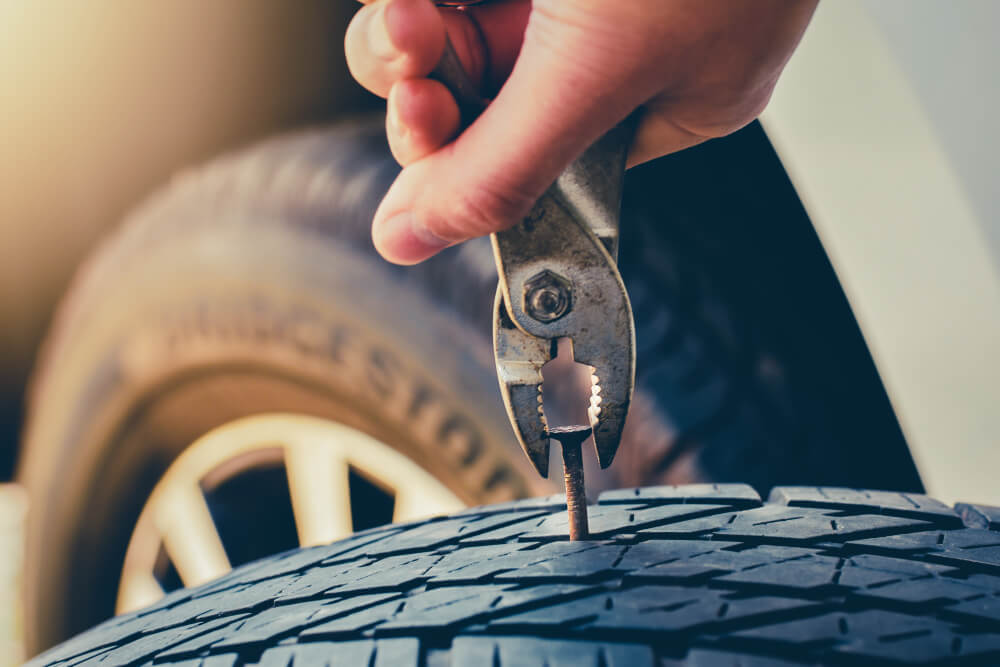
A tire is generally considered repairable when the puncture is located in the central tread area, typically within the inner three-quarters of the tread width. This is where the tire’s structure is strongest and where a proper repair can hold up reliably over time. The puncture should be no larger than one-quarter of an inch in diameter. Most industry guidelines treat anything beyond that measurement as outside safe repair limits. The damage should also have been caused by a nail, small screw, or similarly clean, sharp object. On top of that, the tire needs to have adequate tread depth remaining and no pre-existing structural problems.
It is also worth knowing that a proper repair involves both patching the inner liner and plugging the puncture from the outside. A plug alone is considered a temporary fix, not a permanent solution. If a shop only plugs the tire without removing it from the rim for an internal inspection, that is something worth paying attention to.
This is where being straightforward matters, because driving on a tire that was incorrectly repaired is a real safety risk.
Sidewall and shoulder damage is a firm no for repairs. The sidewall of a tire flexes continuously while the vehicle is moving, and any puncture, tear, or bubble in that area compromises structural integrity in a way that cannot be safely fixed. The shoulder area, which is the curved zone between the tread and the sidewall, falls under the same rule.
Beyond location, several other factors make a flat tire irreparable.
Some of this damage is not visible without removing the tire from the rim and inspecting the inner liner directly, which is exactly why a proper evaluation matters. Beyond knowing when a tire can or cannot be saved, staying prepared before a flat happens is just as important. Knowing what essential items to keep in your car for a tire emergency can make the difference between a quick fix and being stranded.
When a technician evaluates a flat tire, the process goes beyond a quick look at the outside. The technician starts with a visual inspection of the outer tire surface to identify the type and location of the damage. The tire is then removed from the rim so the inner liner can be examined thoroughly. This is the step most people skip when attempting a roadside plug, and it is the most critical part of the whole assessment.
The inner liner reveals whether the tire was driven on while flat, whether any heat damage has occurred, and whether the structural integrity is still intact. The technician also checks for bead damage, which is the area where the tire seals against the rim, and measures the puncture to confirm it falls within repairable limits. An on-site evaluation from a trained technician gives you a faster and more accurate answer than trying to assess the damage on your own from the outside.
A standard patch-and-plug repair typically costs between $15 and $30 at most tire shops. Replacement tire costs vary depending on the vehicle type and tire brand, but a basic replacement generally starts around $80 to $150 per tire and can run higher for larger vehicles or specialty tires.
A repair is noticeably cheaper when the tire actually qualifies for one. That said, choosing a repair when the tire genuinely needs to be replaced is not a cost-saving move. A failed repair on a compromised tire creates a real safety hazard on the road. An honest assessment upfront is always the more cost-effective decision in the long run.
Yes, in many cases it can, but only when the damage meets specific criteria. A puncture in the central tread area that is no larger than one-quarter of an inch and caused by a clean, sharp object is typically repairable. Sidewall damage, blowouts, large punctures, and tires that were driven on while flat generally require a full replacement.
The only reliable way to know which situation you are dealing with is through a proper hands-on inspection. If a flat catches you off guard in Philadelphia, Capstone Towing Company provides mobile flat tire service and can come directly to your location. Give us a call at 267-365-7210 and we will help you figure out the right next step.