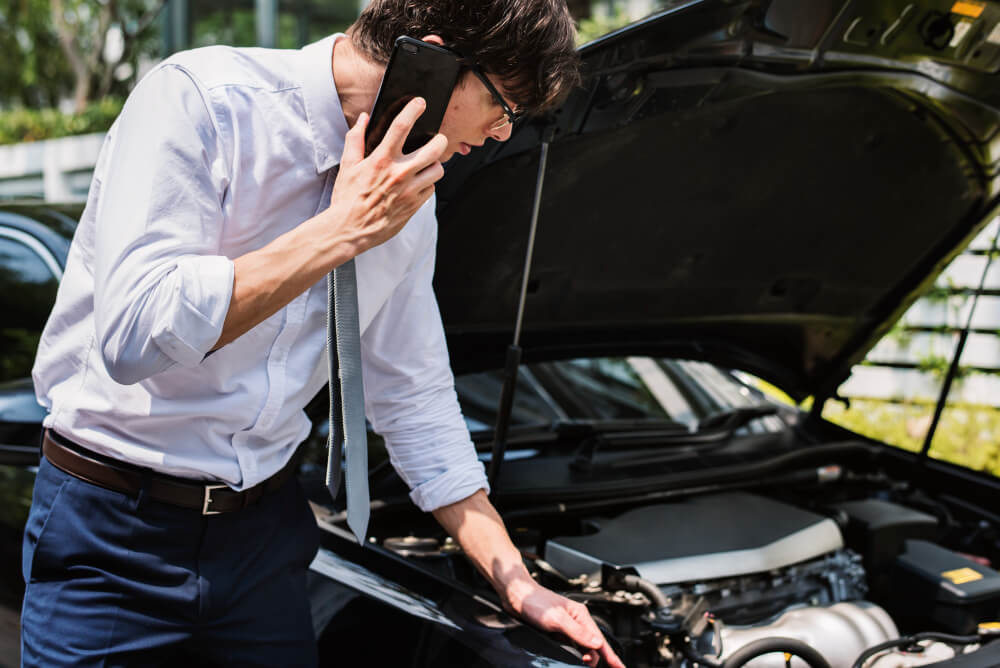

When your transmission fails, the car can suddenly be stuck in place, sometimes in traffic, sometimes in your driveway, and sometimes in a tight Philadelphia street where you cannot afford to guess. If you’re dealing with towing a car with a dead transmission, the main thing to know is this: you can tow it, but the towing method matters a lot. The wrong setup can add damage to the drivetrain or the tires. If you need help arranging a tow and want a flatbed option, Capstone Towing Company is one local contact at 267-365-7210.
Yes, it can be safe to tow a car with a dead transmission, but only if the vehicle is moved in a way that does not force the drive wheels or drivetrain components to spin the wrong way, or spin without proper lubrication. Many transmissions rely on internal pumps and fluid circulation that happen when the engine is running. When the engine is off, some designs do not lubricate the same way, so dragging the vehicle can cause overheating or internal wear.
The practical takeaway: when the transmission is questionable or the car cannot be put into neutral, a flatbed tow is often the simplest way to avoid turning one breakdown into multiple repairs.
People use “dead transmission” to describe several different problems, and each one changes what’s safe.
Sometimes the car will not move under its own power, but it can still shift into neutral. Other times it will not shift out of park. You may also have a transmission that slips badly, makes grinding noises, or triggers warning lights, but still moves a little. From a towing standpoint, the key questions are whether the drive wheels can roll freely and whether the drivetrain can be allowed to rotate.
Vehicle type matters, too. Automatics, manuals, and CVTs all have different internal behavior. Add in modern electronic shifters and brake interlocks, and a car that looks “simple” can still be hard to get into neutral when the battery is dead or a linkage is damaged.
Drivetrain layout is another big factor:
That’s why the safest advice is to treat “dead transmission” as a situation where you should avoid dragging any drive wheels unless you are sure the vehicle is configured for that type of towing.
With a flatbed, the entire vehicle is loaded onto the truck so all four tires are off the ground. That generally avoids rotating the drivetrain during transport, which reduces the risk of transmission and differential damage. It also avoids concerns about whether the car can be shifted into neutral for towing.
Flatbed towing is especially helpful when the car is stuck in park, when the vehicle has AWD, when the steering is locked, or when you suspect other issues like a broken axle, wheel bearing noise, or collision damage.
A tow dolly lifts two wheels off the ground, typically the drive wheels for a front-wheel drive car, while the other two wheels roll on the road. This can be a workable option in some situations, but it is not universal.
For example, if the car is front-wheel drive and the front wheels are on the dolly, the transmission and front drivetrain are not being rotated by the road. That may reduce risk compared to dragging the drive wheels. However, the remaining rolling wheels still matter. Steering and alignment must be controlled correctly, and the vehicle must be secured properly.
Tow dollies become trickier with AWD and some 4WD vehicles because you can still end up rotating part of the drivetrain in a way the manufacturer does not allow. If you are not 100 percent sure what your vehicle permits, it is safer to default to a flatbed.
Wheel-lift towing raises one end of the vehicle by the tires. Like a dolly, it can be fine for certain vehicles in certain conditions, but it requires correct setup. If the drive wheels will be on the ground and rolling, you risk turning transmission components without the engine running. That is often where extra damage happens.
Sometimes a wheel-lift tow can be made safer by using additional equipment or procedures, but the correct approach depends on the vehicle. If your car is AWD or the transmission is locked up, wheel-lift towing is more likely to be problematic than a flatbed.
A lot of transmission-related towing damage comes from well-intentioned shortcuts.
Avoid letting someone “just pull it” with a strap or chain to move it any distance on the road. Even if it gets the car out of the way, uncontrolled dragging can chew up tires, stress suspension components, and rotate driveline parts in ways the car was not designed to handle. It can also be dangerous in traffic.
Avoid forcing the shifter or trying to muscle the car into neutral. Many vehicles have interlocks tied to the brake pedal, battery power, or electronic modules. If it won’t shift, there may be a reason, and forcing it can break the shifter mechanism.
Also double-check basics before the tow: if the steering wheel is locked or the parking brake is on, the car may not roll. A locked wheel can cause the vehicle to skid during loading, which can damage tires and increase the risk of a loading mishap.
You do not need to be a mechanic to make the tow go smoother and reduce the chance of additional problems. A few minutes of preparation can help.
First, look up your vehicle’s towing instructions in the owner’s manual or the manufacturer’s online guide if you can access it. You are looking for what the manufacturer allows for “recreational towing” or “emergency towing,” and any special notes for AWD or a CVT.
If the vehicle can be put into neutral safely and you can do so without forcing anything, that may help with loading. Some cars have a manual shift release or a procedure for electronic shifters. Follow the documented steps if you have them, and stop if something does not feel right.
Remove valuables and essential items before the vehicle is loaded. Once a car is on a truck, access can be limited. It is also smart to document the vehicle’s condition with a few photos, especially if the breakdown followed an incident like hitting a curb, pothole, or another car.
One of the easiest ways to speed up help and reduce risk is to give clear information up front. When calling, try to share:
Those details help the dispatcher send the right equipment. If you are in a situation where towing a car with a dead transmission is likely to require a flatbed, saying “the car won’t go into neutral” or “it’s AWD and stuck in park” can make that clear without you needing to diagnose the vehicle.
Some transmission failures happen in inconvenient places. If the car is nose-in to a curb, parked on a steep slope, wedged in a tight spot, or has wheels that will not roll, loading may require winching rather than driving it onto a bed. That is normal in towing, but it is another reason not to try to “solve it” by dragging the car with a personal vehicle.
After an accident, the situation can be more complicated. A transmission problem might not be the only issue. A bent suspension component, a damaged wheel, or a broken axle can change how the car should be moved. In those cases, the goal is not just towing, but towing without adding secondary damage.
A dead transmission does not mean your car cannot be towed. It means you should be careful about how it’s towed. The safest path is usually the one that avoids spinning the drivetrain with the engine off, especially if the car is AWD, stuck in park, or you cannot confirm the manufacturer’s towing rules. If you are uncertain, it is reasonable to request a flatbed rather than risk dragging the drive wheels.
If you need help getting your vehicle moved in Philadelphia and want to avoid compounding transmission damage, you can call Capstone Towing Company at 267-365-7210 and we’ll help you choose a safe towing approach for your situation.